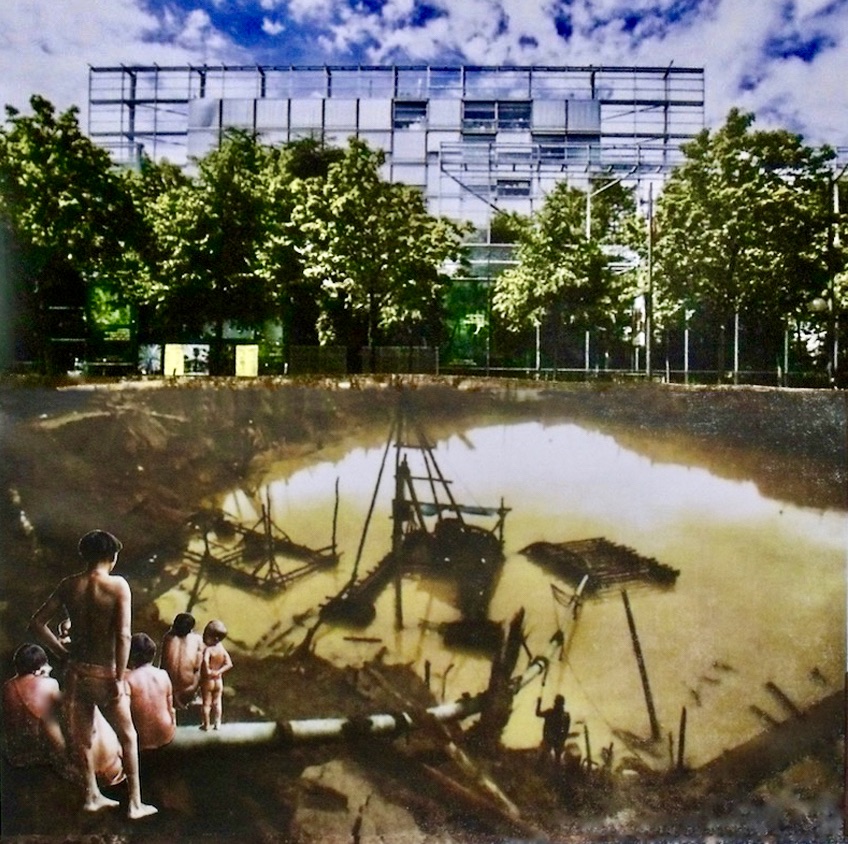
Cartier‘s True Nature 1 – Cartier Foundation/Yanomami at gold mining site – photo montage: Barbara Crane Navarro
The Fondation Cartier presented the exhibition “The Yanomami Struggle” in 2020 while the Yanomami struggled (and are still struggling now) against the gold industry which is destroying their territory!
Yes, the Cartier Foundation “supports” a people, the Yanomami, victims of an activity, the extraction of gold, which precisely enriches the Cartier luxury jewelry and watch business!
Later, the Cartier “The Yanomami Struggle” exhibition was shown at the Triennale Milano until February 2021.

photo montage: “Pas de Cartier” series – Barbara Crane Navarro – with advertisement for Cartier and photo of gold mining site in indigenous territory by João Laet
As for the NGO Survival – according to their website: “We are fighting for the survival of indigenous peoples. We prevent loggers, gold diggers and oil companies from destroying the land, lives and futures of indigenous peoples around the world.”
Rather than giving speeches inside during “The Yanomami Struggle” opening at the Cartier Foundation on January 30, 2020, representatives of Survival should have been outside the Cartier Foundation to protest with signs such as “Stop the greenwashing of dirty gold and blood diamonds!” and “Pas de Cartier!”
Representatives of Survival could have been outside the the Triennale Milano to protest with signs such as “Stop the greenwashing of dirty gold and blood diamonds!” and “Pas de Cartier!” at the inauguration of the Triennale Milano / Fondation Cartier exhibition …but that didn’t happen, either.

photo: advertisement Triennale Milano / Fondation Cartier
The General Director of the Cartier Foundation, Hervé Chandès, details in an interview with Caroline Lebrun how the Cartier Foundation is overseen by the luxury gold watch and jewelry company Cartier: “The Foundation is private, fully funded by Cartier for its communication.”
https://www.paris-art.com/herve-chandes-fondation-cartier/None of their luxury gold baubles are on sale at the foundation, but Cartier, a merchant of luxury gold items since 1847 with a turnover of 441,351,000 € as of 31 March 2019, created its foundation with funds from the sale of gold and diamond luxury jewelry, watches and accessories.
Alain-Dominique Perrin is a French businessman who joined Cartier in 1969 as a commercial attaché to develop sales. He was president of the Cartier company from 1975 to 1998 and founder, in 1984, of the Cartier Foundation for contemporary art.
In the early 1980s, with the arrival of the leftist government, Perrin reflected on the best way to register his mark in this new civil society. He identified “Art patronage” as the best lever for the luxury industry. In 1984, he founded the Cartier Foundation for Contemporary Art, a completely innovative corporate sponsorship initiative. In 1986, the Minister of Culture appointed him project manager for corporate sponsorship. A new French law regarding corporate sponsorship was adopted in July 1987.
In 1994, the foundation moved to its current location in a glass building designed by the architect Jean Nouvel surrounded by a modern wooded garden. In 2011 Perrin asked Jean Nouvel to draw up preliminary plans for a new base on Île Seguin. In 2014, the foundation abandoned plans to relocate to the island and instead instructed Nouvel to work on the expansion of its current premises.
Perrin became, in 1999, vice-president of the Richemont group, a Swiss holding company specializing in luxury items (which includes Cartier, Van Cleef & Arpels and Piaget).
Richemont is today the world’s second largest luxury group in terms of turnover, behind LVMH. The French luxury brand Cartier is the flagship of the Richemont group, representing half of its total turnover and two thirds of its accounting results.
The Richemont Financial Company, specializing in the luxury industry, was founded in 1988 by the South African billionaire Johann Rupert when the Rupert family separated their foreign assets from their South African assets in order to avoid international sanctions targeting the apartheid regime. The group launched with actions in Cartier Monde SA and Rothmans International. In the 1990s, the group’s activities were divided into two areas: Rothmans International for tobacco and Vendôme Luxury Group for fashion and luxury. In 2008, Richemont took a strategic turn and chose to focus only on luxury. Perrin retired in December 2003 but remained a director of SCI Financière Richemont and continued to advise the group.
The following is from Richemont’s 2019 corporate social responsibility report: “It shows how we meet our commitments and describes how we manage our social, ethical and environmental impacts. As a responsible luxury goods company, we seek to improve life at all levels of the luxury value chain. Among the highlights of the year were the development of our transformational CSR strategy, an updated review of materiality and significant developments within the Responsible Jewelry Council. In addition, our companies collaborated with WWF in its examination of the main Swiss watchmaking and jewelry companies.”
Human Rights Watch’s assessment of Cartier‘s business practices can be found in an article from professionaljeweler.com: “Cartier is owned by Richemont, a luxury goods group based in Switzerland and represents approximately 45% of Richemont’s turnover. Chain of Custody: Cartier has a chain of custody for some, but not all, of its gold. It does not indicate if it has a chain of custody for diamonds … Cartier‘s corporate responsibility policy does not mention traceability … Cartier‘s parent company, Richemont, says traceability is a long-term goal and a focus for improvement for all their businesses in the years to come. According to Richemont’s Supplier Code of Conduct, suppliers are required to demonstrate that they exercise human rights due diligence, but it is not clear whether Cartier enforces this provision. Cartier did not respond to Human Rights Watch’s request for a meeting.”
It’s clearly vital for Survival International, as well as for WWF, to denounce the luxury gold industry, dirty blood gold that destroys forests and Indigenous lives, instead of collaborating with them…
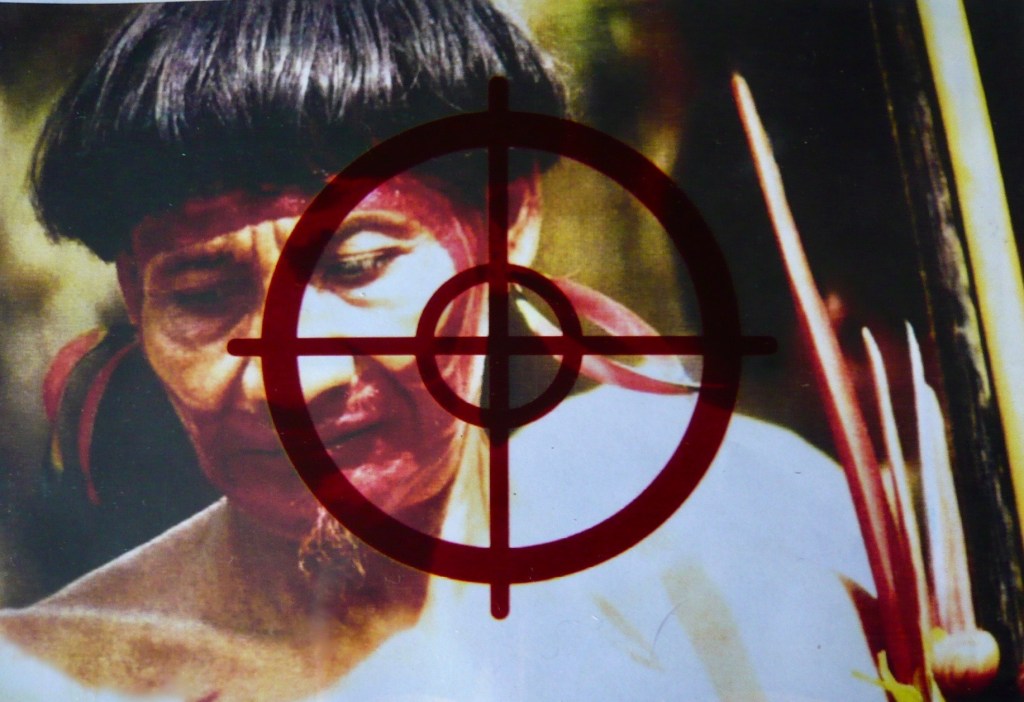
“Targeted Yanomami Man”
photo montage – Barbara Crane Navarro
To paraphrase Davi Kopenawa: “The luxury jewelry industry is a trap for the Yanomami people. Cartier uses their “friendship” to deceive and manipulate us. What they want is to extract our wealth and send it to other countries. The wealth of our Yanomami land, they will take it and send it to China, Japan, Germany and elsewhere. It’s their way of thinking. It’s their concern, earning money, earning money to get rich.”
There was an article in Télérama at the beginning of Cartier‘s exhibition “The Yanomami Struggle” with a photo of a Yanomami man on the cover. The article did not take into account the fact that the Cartier Foundation “supports” a people, the Yanomami, who are victim of an activity, gold extraction, which precisely enriches the Cartier company!
It was reminiscent of 2011, when the French oil company Perenco sponsored the show “Mayas: from dawn to dusk” at the musée du quai Branly. Of course, the Mayans were only considered during the classical period until about the 10th century. Consequently, the question that was asked in the museum but also in the press was “Is a dead Maya more interesting than a living Maya?”
Perenco even went so far as to finance a “Green Battalion” made up of Guatemalan soldiers, supposedly to protect the environment. In reality, this battalion harassed and forced off their land the Mayan peasants living in the areas where Perenco established its oil wells. Gregory Lassalle made a documentary film on the subject (“From the excesses of art to petroleum derivatives” (2011) and a previous film, “The gold business in Guatemala” (2007).
There are links below from 2011 in which the media was definitely more critical of the dominant industrial model at the time…
“A disputed patron of the ‘Maya’ exhibition at Quai Branly. Can we extract oil in a natural park and sponsor an exhibition on one of the great civilizations of pre-Columbian America? The question is raised by the Collectif Guatemala on the occasion of the opening, Tuesday June 21, of the exhibition ‘Maya, from dawn to dusk’, at the Quai Branly museum. The Franco-British company Perenco, implicated, receives support from scientific advisers at the exhibition.”
https://www.telerama.fr/scenes/un-mecene-conteste-a-l-expo-maya-du-quai-branly,70441.php“GUATEMALA. Expo Maya at Quai Branly: a cumbersome patron Associations denounce the environmental impacts in the Laguna del Tigre nature reserve of the Perenco oil company. Several French and Guatemalan associations chose June 20 to denounce in France the actions of the Franco-British oil company Perenco in Guatemala, on the eve of the opening of the Maya exhibition at the Quai Branly museum. The oil company, which burnishes its image by providing patronage for this exhibition, is accused by these associations of not respecting Guatemala’s environmental heritage.”
https://www.nouvelobs.com/monde/20110621.OBS5582/guatemala-expo-maya-au-quai-branly-un-mecene-encombrant.htmlFor more detailed information, please read:
The GENOCIDE of the YANOMAMI and the DEATH of NATURE for Gold and Diamond Merchandise – The ART of GREENWASHING by the MERCHANTS of GOLD – in their own words… UPDATED September 2023!
and
« No to GOLD! – No to Cartier ! » Yanomami and Trees versus Gold Mining, Mercury poisoning and Gold Luxury items / Exhibition 2023
Thank you! Barbara

 Barbara Crane Navarro
Pingback: Is Art just another luxury item? – Pas de Cartier ! – updated ! | Barbara Crane Navarro | Ned Hamson's Second Line View of the News
🖤
LikeLiked by 1 person
🦋🦉🐦🐯💚🌍🙏💚🐻🐸🐰🐵🐒
LikeLike