
« I do not see a delegation for the Four Footed. I see no seat for the Eagles.
We forget & we consider ourselves superior. But we are after all a mere part of Creation.
We stand somewhere between the mountain & the Ant. »
– Chief Oren Lyons, Seneca Nation, in an address to the Non-Governmental Organizations of the United Nations, Geneva, Switzerland, 1977

« The last 500 years witnessed a ‘swift, ongoing, radical reorganization of life on Earth without geological precedent’ – the arrival of European colonialism, imperialism and the associated expansion of capitalist economic systems leading to the transferral of diseases, plants, animals, forms of land use, and administrative systems to all corners of the world. »
According to the UN, we are entering an « era of pandemics » caused by deforestation, habitat loss, intensive agriculture and wildlife trafficking.
The Intergovernmental Panel on Climate Change (IPCC) stated that one of the most crucial ways to reduce carbon emissions is to shift towards a plant-based diet.
The meat industry is responsible for producing more climate pollution than all of the world’s cars, ships, trucks, and planes combined.
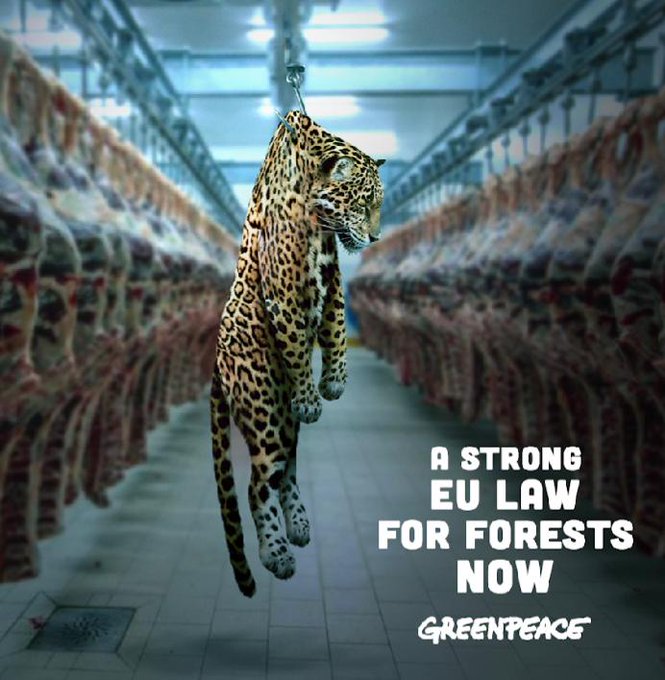
The protection of global forests will be on the agenda at the COP26 climate summit. Nations are expected to propose more ambitious goals in the hope of reducing damage to the climate. Many pledges will be « net » targets that rely on forests to remove a certain amount of carbon from the atmosphere.
The summit host, the UK government, includes forestry as a key issue for discussion with a focus on imported deforestation – trees being felled because of pressure from supply chains in the Global North. This consumer-fueled pressure has caused the destruction of immense areas of rainforest, rich in biodiversity, that were capable of capturing large amounts of carbon.
The EU is responsible for 16% of deforestation related to international trade, second only to China, and intends to propose legislation to prevent imported deforestation within the EU following the COP26 summit.
Government and corporative initiatives are important but, as we’ve seen for decades, good intentions and inspiring speeches aren’t necessarily followed with action.

We as consumers can play an important role by making choices that can help prevent global forests from being totally destroyed. What we choose to eat and consume has an impact on biodiversity and indigenous peoples thousands of kilometers away from our homes.
We should ask ourselves: What do we really need to purchase? What do we really need to eat?
Purchasing locally-sourced, in season items that don’t travel 3000 kilometers helps combat deforestation globally. Put simply, if it isn’t grown or produced nearby, don’t buy it. We can limit forest and habitat destruction by boycotting products from deforestation; palm oil, soy, meat and also exotic wood, gold, diamonds…
Our actions now will determine the future for ourselves and the rest of the living world.

« I do not see a delegation for the Four Footed. I see no seat for the Eagles.
We forget & we consider ourselves superior. But we are after all a mere part of Creation.
We stand somewhere between the mountain & the Ant. »
– Chief Oren Lyons, Seneca Nation, in an address to the Non-Governmental Organizations of the United Nations, Geneva, Switzerland, 1977

 Barbara Crane Navarro
Well said, Barbara. And COP26 is less than a week away… 🌍
LikeLiked by 1 person
Thank you! 🌍!
LikeLiked by 1 person
You are welcome 🌍
LikeLiked by 1 person
Pingback: COP26 – Call to Action! We all must revise our relationship with nature and reorient our association with consumerism! — Barbara Crane Navarro – Tiny Life
Reblogged this on Ned Hamson's Second Line View of the News.
LikeLiked by 1 person
Very relevant words, we must all individually works to save our environment from further degradation.
LikeLiked by 1 person