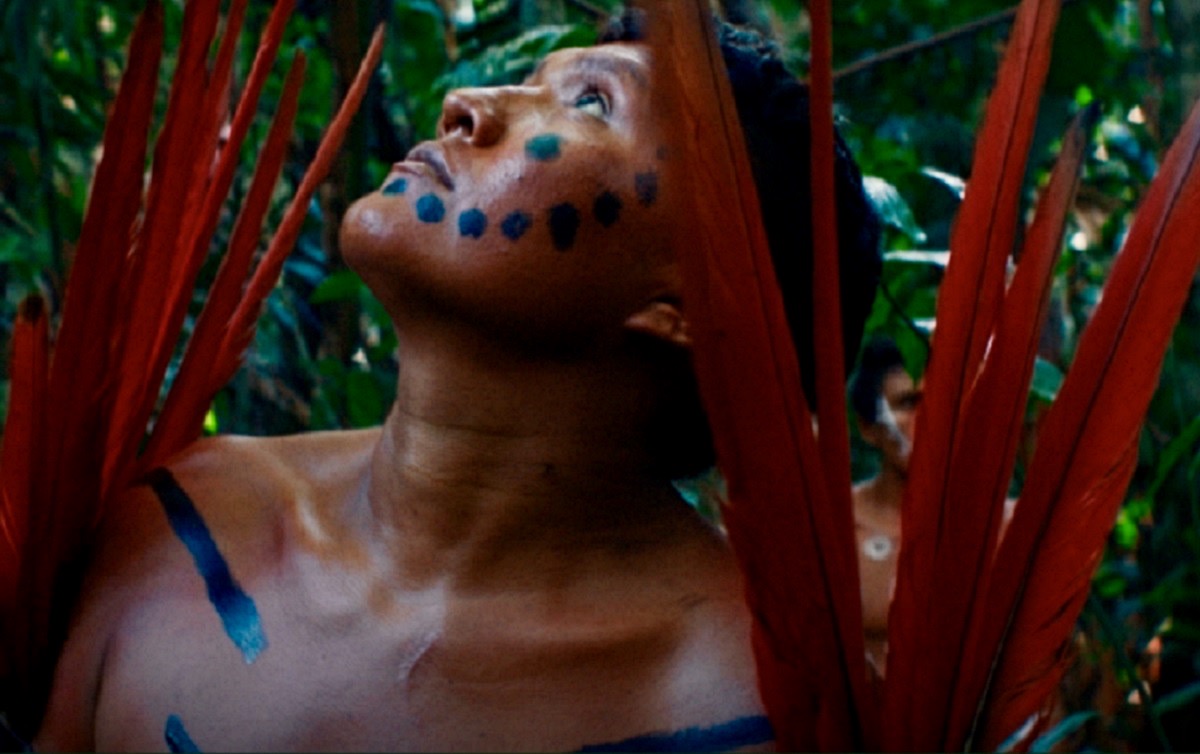
Yanomami men in the forest – photo: Gullane/Pedro J Marquez
A conflict erupted on April 27, when a group of Yanomami intercepted illegal gold miners who were going up the Rio Uraricoera in a speedboat loaded with fuel for their planes, helicopters and the industrial excavating machines they use for uprooting trees and moving soil. The Yanomami seized 990 liters of fuel. Then, another group of gold miners heading downriver to Boa Vista fired guns at the Yanomami in an attempt to intimidate the indigenous community who have been trying for years to prevent illegal gold miners from coming up the rivers into their territory.
On April 30th, Yanomami contacted government authorities to alert them regarding the episodes of violence in the Palimiú region. The region consists of 1,129 indigenous people in 15 villages.
No effective action was taken by the state security forces.
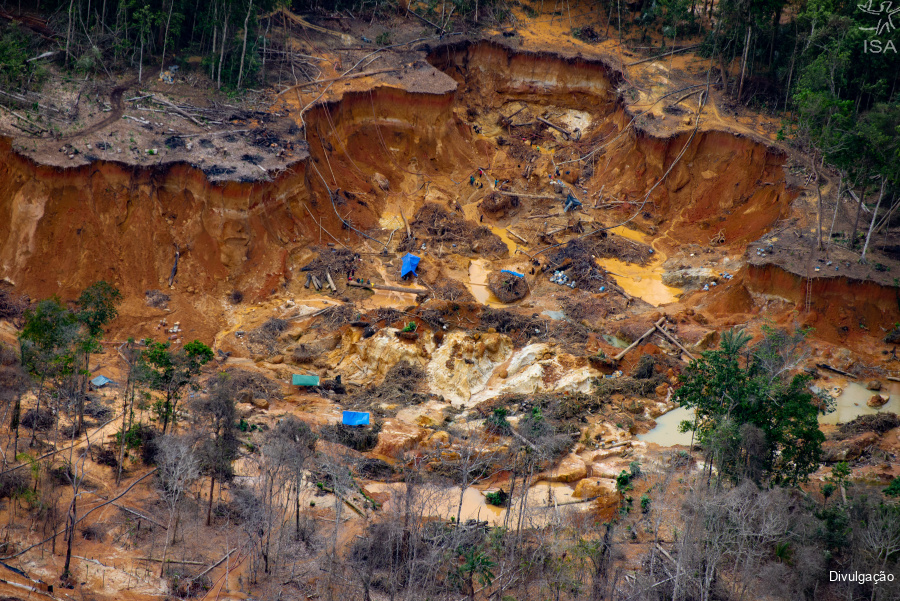
Gold mining site in indigenous territory
The village of Palimiú was attacked on May 10th by gold miners coming by boat on the Uraricoera river. Two Yanomami children drowned as the panicked women and children of the community rushed to safety.
The Yanomami contacted the authorities again asking for urgent help to prevent violence and guarantee security in Palimiú.
May 12th saw another armed confrontation at Palimiú between gold miners, indigenous people and, this time, Federal Police agents who were also fired at by the miners.
The Yanomami contacted the Army requesting that an emergency security post be established in the Palimiú region.
On May 13th, dozens of boats with gold miners arrived near Palimiú and the authorities were alerted that miners were apparently organizing in order to initiate new attacks.
15 boats of gold miners approached the Palimiú community on May 17th. The Yanomami told the authorities that, in addition to gunshots, there was a lot of smoke and their eyes were burning, indicating the use of tear gas canisters by the gold miners.

March 2021 satellite images indicated an accumulated total of 2,430 hectares of devastated forest – « The gold miners that attack the Yanomami of the Palimiu community are also killing the rivers of the Yanomami indigenous land in Roraima »
On May 24 the Minister of the Supreme Federal Court, Luís Roberto Barroso, determined that the federal government should immediately take “all necessary measures” to protect the life, health and safety of indigenous populations in the Yanomami and Munduruku Indigenous Lands, both invaded by gold miners. According to the minister’s decision, the government must send all the necessary security personnel and remain in place as long as the risk persists, involving the Federal Police, National Public Security Force, FUNAI, Brazilian Institute for the Environment and Renewable Natural Resources (IBAMA) and, if applicable, the Armed Forces.
Another Yanomami statement on June 1st detailed an armed attack by gold miners at the Conservation Unit of the Maracá Ecological Station in Roraima. The invaders use the stretch of river that runs across the Conservation Unit as a supply route for illegal gold mining sites.
Leaders of the Maikohipi community, in the Palimiú region, said that gold miners arrived with four boats on June 5th, lobbing gas bombs toward the community. As the attack began and before the gold miners entered their community, the Yanomami took refuge in the woods. The gold miners killed Yanomami hunting dogs as a warning and a threat…
Another official letter dated June 7th narrated a new attack on the Maikohipi community in the Palimiú region, again with tear gas bombs.
On June 8th gold miners attacked the Walomapi community in the Palimiú region. The Yanomami were returning from a hunt when they were shot at by gold miners on the Rio Uraricoera and had to dive into the water to escape the attack.
Finally, on June 14th, the Brazilian government authorized the deployment of the National Security Force to protect the Yanomami indigenous people and their ancestral territory for 90 days.
A group of hooded gold miners attacked the Korekorema community on June 16th, firing guns at the houses of the community and forcing the Yanomami to hide in the forest. Korekorema formerly had an Ethno-environmental Protection Base (BAPE) which was deactivated by the Federal Government “due to lack of funds”. The base’s objective was to protect the indigenous people and prevent illegal activities such as gold mining and deforestation. Last year, the Federal Court ordered FUNAI to reactivate the site, but so far, they have not responded…
On June 17th, 6 children and 2 young people from the Tipolei community were fishing in the Rio Uraricoera when a boat with 5 armed gold prospectors approached and accelerated, capsizing and sinking their canoe. The children and young people swam across the river and fled through the woods to Yakepraopë.

Yanomami Blood Gold
Over the year between April 2020 and May 2021 Yanomami informed the government more than a dozen times regarding the rapid expansion of illegal mining with approximately 20,000 invaders exploiting the region in search of gold. These documents emphasized that the presence of gold miners threatens the safety of indigenous communities, contaminates the environment and propagates coronavirus as well as other diseases.
The gold miners invade, excavate and threaten with impunity as a consequence of President Bolsonaro’s election promise to permit mining in indigenous territories and his subsequent presentation of a bill to grant mining concessions that would encompass a third of indigenous territory in Brazil.
Gold mining and the indiscriminate use of mercury to ferret out gold are turning swaths of the world’s most biodiverse ecosystems of the nine countries that comprise the Amazon region into a nightmarish moonscape!
Worldwide, illegal gold mining is more lucrative for criminal organizations, drug cartels, guerrilla groups and mafias than drug trafficking. For criminals posing as precious metals dealers, gold is the perfect medium for laundering illicit money from other illegal activities since illegal gold looks exactly like legal gold and the proceeds from selling it can be placed in the bank.
The current gold rush in the Amazon region is detailed here: report
PLEASE DO NOT BUY OR USE GOLD!
As much as 75% of the gold extracted each year is used for jewelry, watches and other vain and futile status symbols sold by corporations in the luxury industry as well as discount retailers worldwide.
Tens of thousands of rainforest trees must be uprooted, hundreds of tons of soil mined and mixed with dozens of tons of toxic environmental pollutants that contaminate indigenous lands for that one special gold ring…
Please give gifts that don’t destroy nature and the lives of indigenous peoples!
« If the gold miners dig everywhere like wild pigs, the forest’s rivers will soon be no more than miry backwaters, full of mud, motor oil, and trash. They also wash their gold powder in the streams, mixing it with mercury. All these dirty and dangerous things make the waters sick and the fish’s flesh soft and rotten. »
- Yanomami spokesperson and shaman Davi Kopenawa who denounces Brazilian government inaction in the face of violent incursions by heavily armed illegal gold miners
Please listen here to the Yanomami shaman’s message:
LISTEN TO THE YANOMAMI SHAMAN’S MESSAGE

 Barbara Crane Navarro
Reblogged this on Ned Hamson's Second Line View of the News.
LikeLiked by 1 person
Pingback: A month of violent attacks by gold miners against Yanomami communities without protection from the Brazilian state! – «If the gold miners dig everywhere, the forest’s rivers will be full of mud, motor oil, and trash. They wash their gold powder in th
Pingback: « They want to find GOLD – Their avidity was what made most of our elders die long ago! *White men who have money, want more. They want to destroy more. That’s their tradition – they’ve got no limit! » | Barbara Crane Navarro
Pingback: « Money does not protect us … it does not create our joy. For *white people, it is different. » | Barbara Crane Navarro